
Research

Research

Dr. Blum’s research focuses on party factions, party coalitions, congressional communication, and public opinion about Congress. Here’s a list of her recent publications and projects.

Books

Articles

Book chapters

In progress: 

  • “Comparative Party Factions” (article and book project with Mike Cowburn and Amelia Malpas).
  • “Does the Medium Change the Message? Comparing Results Across Five Mediums of Congressional Text” (working paper with Kelsey Shoub and Jon Green).
  • “Experimental Evidence on the Effects of Campaign Funds for Childcare” (preparing for submission with Peter McLaughlin, Joy Rhodes, Nathan Barron, Bennie Ashton, Chuck Finocchiaro, and Michael Crespin).
  • “The Politics of Ableism and Support for Disability Policy” (working paper with Monica Schneider).
  • “Unveiling Ableism: A Conjoint Experiment on Disability and Electability” (working paper with Josh McCrain).

Dr. Blum’s research focuses on party factions and their impact on contemporary US politics. Along with her 2020 book, How the Tea Party Captured the GOP (University of Chicago Press), this includes a recent article in Perspectives on Politics, “Trump-ing Foreign Affairs: Status Threat and Foreign Policy Preferences on the Right” (with Christopher Parker).

Dr. Blum’s research agenda encompasses several ongoing projects. Projects near completion or under review include: The Enemy Within, a book manuscript hat explores the MAGA movement and its impact on American democracy (with Chris Parker, read more about our MAGA panel study below); Parties in Miniature: Where Factions Fit in U.S. Party Coalitions, a working draft of a chapter for an edited volume about contemporary parties; “Legislative Communication: The Media of Choice across Congress,” a comprehensive analysis of constituent-facing Congressional communication (with Kelsey Shoub and Lindsey Cormack, under review); “How Local Factions Pressure Parties: Activist Groups and Primary Contests in the Tea Party Era,” an article using a difference-in-difference research design to assess the Tea Party’s impact on contemporary parties and polarization (with Mike Cowburn, under review); “Measuring Partisanship in Congressional Speech,” which uses machine learning techniques to generate member-level ideology estimates using five corpora of public speech (with Kelsey Shoub, Jon Green, and Lindsey Cormack); “Factions in Party Nomination Networks,” a network-based analysis of presidential endorsement patterns (with Hans Noel); and “Representation, Responsiveness, and COVID-19,” a comprehensive research project examining the political roots of inequities in the U.S. domestic COVID-19 response (Russell Sage Grant Proposal with William Bianco and Josh McCrain, revise and resubmit).

View & Download
Complete CV

Select Publications

How the Tea Party Captured the GOP: Insurgent Factions in American Politics

(University of Chicago Press, forthcoming August 2020).

The rise of the Tea Party redefined both the Republican Party and how we think about intraparty conflict. What initially appeared to be an anti-Obama protest movement of fiscal conservatives matured into a faction that sought to increase its influence in the Republican Party by any means necessary. Tea Partiers captured the party’s organizational machinery and used it to replace established politicians with Tea Party–style Republicans, eventually laying the groundwork for the nomination and election of a candidate like Donald Trump.

In How the Tea Party Captured the GOP, Rachel Marie Blum approaches the Tea Party from the angle of party politics, explaining the Tea Party’s insurgent strategies as those of a party faction. Click here for more.

Cooperating Factions: A Network Analysis of Party Divisions in U.S. Presidential Nominations

Published by Cambridge University Press, 2024 (with Hans Noel). More info here.

Popular accounts of presidential nomination politics in the United States focus on factions, lanes, or even a civil war within the party. This Element uses data on party leader endorsements in nominations to identify a network of party actors and the apparent long-standing divisions within each party. The authors find that there are divisions, but they do not generally map to the competing camps described by most observers. Instead, they find parties that, while regularly divided, generally tend to have a dominant establishment group, which combines the interests of many factions, even as some factions sometimes challenge that establishment. This pattern fits a conception of factions as focused on reshaping the party, but not necessarily on undermining it.

Cross-Platform Partisan Positioning in Congressional Speech

Jon Green, Kelsey Shoub, Rachel M. Blum, Lindsey Cormack, Cross-Platform Partisan Positioning in Congressional Speech, Political Research Quarterly (published online March 2024), doi:10.1177/10659129241236685.

How Local Factions Pressure Parties: Activist Groups and Primary Contests in the Tea Party Era

Rachel M. Blum and Mike Cowburn, How Local Factions Pressure Parties: Activist Groups and Primary Contests in the Tea Party Era, British Journal of Political Science (published online June 2023), doi:10.1017/S0007123423000224.

Conditional Congressional Communication: How Elite Speech Varies across Medium

Blum, Rachel, Lindsey Cormack, and Kelsey Shoub. Conditional Congressional Communication: How Elite Speech Varies across Medium. Political Science Research and Methods 11, no. 2 (2023): 394–401. doi:10.1017/psrm.2022.28.

Trump-ing Foreign Affairs: Status Threat and Foreign Policy Preferences on the Right.

Rachel Blum and Christopher Parker. Perspectives on Politics 17, no. 3 (September 2019): 737-755. (Replication files) Click here for more.

Who Decides? Media, MAGA, Money, and Mentions in the 2022 Republican Primaries

Rachel Blum, Mike Cowburn, and Seth Masket, Who Decides? Media, MAGA, Money, and Mentions in the 2022 Republican Primaries, Political Research Quarterly (published online July 2024), doi:10.1177/106591292412688. Supplementary material.

Presidential Endorsements as Voter Cues: Evidence from the 2022 Midterm Elections

Nathan T. Barron, Peter T. McLaughlin, H. Benjamin Ashton III, Rachel M. Blum, Charles J. Finocchiaro & Michael H. Crespin, Presidential Endorsements as Voter Cues: Evidence from the 2022 Midterm Elections, Political Behavior (published online July 2025).

Supplementary and replication materials.

Ends Versus Means: Public Opinion on Congressional Redistricting

Peter T. McLaughlin, Peter Olson, Nathan T. Barron, H. Benjamin Ashton, III, Rachel Blum, Charles J. Finocchiaro, and Michael H. Crespin, Ends Versus Means: Public Opinion on Congressional RedistrictingElection Law Journal (published online August 2025), doi:10.1089/elj.2023.0050.

The Asymmetry of Movement-Factions in the Democratic and Republican Parties

Rachel Blum, “The Asymmetry of Movement-Factions in the Democratic and Republican Parties,” in Parties, Power, and Change: Developmental Approaches to American Party Politics, eds. Adam Hilton & Jessica Hejny (University of Pennsylvania Press, 2025).

Exploring the Motivations of the MAGA Movement

Christopher Parker and Rachel Blum, “Exploring the Motivations of the MAGA Movement,” in Connective Action and the Rise of the Far-Right Platforms, Politics, and the Crisis of Democracy, eds. Steven Livingston and Michael Miller (Oxford University Press, 2025).

“Student-Run Exit Polls 101.”

Croco, Sarah E., Elizabeth Suhay, Rachel Blum, Lilliana Mason, Hans Noel, Jonathan Ladd, and Michael A. Bailey. PS: Political Science & Politics 52, no. 2 (2019): 361–66. doi:10.1017/S1049096518002330. Click here for more.

Publications

How the Tea Party Captured the GOP: Insurgent Factions in American Politics

(University of Chicago Press, forthcoming August 2020).

The rise of the Tea Party redefined both the Republican Party and how we think about intraparty conflict. What initially appeared to be an anti-Obama protest movement of fiscal conservatives matured into a faction that sought to increase its influence in the Republican Party by any means necessary. Tea Partiers captured the party’s organizational machinery and used it to replace established politicians with Tea Party–style Republicans, eventually laying the groundwork for the nomination and election of a candidate like Donald Trump.

In How the Tea Party Captured the GOP, Rachel Marie Blum approaches the Tea Party from the angle of party politics, explaining the Tea Party’s insurgent strategies as those of a party faction. Click here for more.

Trump-ing Foreign Affairs: Status Threat and Foreign Policy Preferences on the Right.

Rachel Blum and Christopher Parker. Perspectives on Politics 17, no. 3 (September 2019): 737-755. (Replication files) Click here for more.

“Student-Run Exit Polls 101.”

Croco, Sarah E., Elizabeth Suhay, Rachel Blum, Lilliana Mason, Hans Noel, Jonathan Ladd, and Michael A. Bailey. PS: Political Science & Politics 52, no. 2 (2019): 361–66. doi:10.1017/S1049096518002330. Click here for more.

Partisan Conflict and Congressional Outreach

Solomon Messing, Patrick Van Kessel, Adam Hughes, Nick Judd, and Rachel M.Blum,

“Partisan Conflict and Congressional Outreach,” a Pew Research Center Report

(February 2017). Click here for more. 

Is there such a thing as a Conservative Foreign Policy?

Rachel M. Blum and Christopher S. Parker, “Is there such a thing as a Conservative

Foreign Policy?” in the Brookings Governance Series (October 2014).

Click here for more. 

A Tangled Web: Religion and the Regime in the US

Rachel M. Blum and Clyde Wilcox, “A Tangled Web: Religion and the Regime in the

US,” in Religion and Regimes: Support, Separation, and Opposition, eds.Ted Jelen and

Tehran Tamadonfar (Lexington: Lexington Books, 2013).

Click here for more. 

Panel Study Of The MAGA Movement

Panel Study Of The MAGA Movement

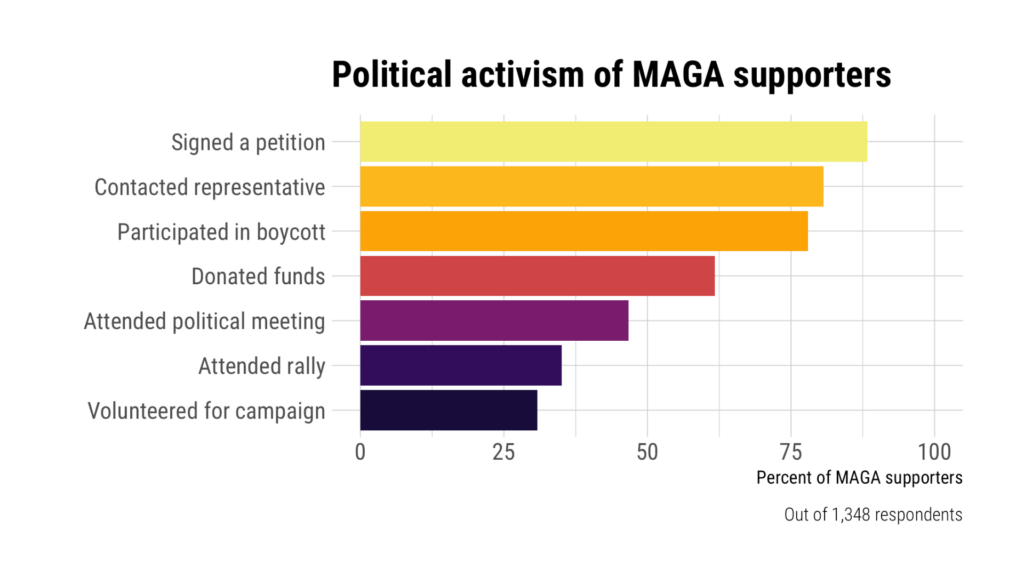
The Panel Study of the MAGA Movement (PSMM) is a survey designed to assess the attitudes and behavior of the people who consider themselves part of the “Make America Great Again” movement, popularized by the Trump campaign in 2016.

© Copyright 2021 · Dr. Rachel Blum, PhD by Align Digital Consulting

© Copyright 2021 · Dr. Rachel Blum, PhD by Align Digital Consulting